



Foundation Crack Repair in Knoxville: Field Notes from the Ridge-and-Valley
Knoxville sits in the Ridge-and-Valley Appalachians beside the Tennessee River, where thick red clay residual soil covers karst limestone and dolomite. That geology matters for any Foundation Crack Repair in Knoxville: clay swells when it soaks up spring rain and shrinks in dry spells, and the ground beneath older homes can settle into voids in the limestone. In Fourth and Gill and Old North Knoxville, 1880s to 1910s brick and limestone foundations carry a century of that movement. In Farragut and Hardin Valley, poured walk-out basements from the 1990s and 2000s crack along cold joints and form ties.
We inspect every crack before we touch it. A hairline shrinkage crack in a 1950s West Hills ranch is not the same problem as a widening diagonal crack in a Holston Hills Tudor on a steep lot. If you want the full picture of how water moves around your foundation, start with a free basement inspection before you commit to any repair method.
Why Cracks Open Here: Red Clay, Karst, and Knoxville's Steep Lots
The failure mode that dominates Knoxville is hydrostatic pressure from saturated red clay pressing against basement walls after heavy spring storms. Water tables rise fast along First Creek and Third Creek bottoms, and long ridges push runoff toward uphill walls on sloped lots in Sequoyah Hills and Fountain City. Freeze-thaw cycles in January and February widen existing cracks a fraction more each winter, and humid summers keep the clay working against the foundation.
- Shrinkage cracks appear as vertical lines in poured walls and are usually the least serious.
- Diagonal cracks that step along mortar joints in block or brick walls often signal settlement or lateral pressure.
- Horizontal cracks with a bowing wall are structural and need carbon fiber straps or wall anchors, not injection alone.
- White efflorescence powder on the wall means water is moving through the concrete and leaving salts behind.
If you see any of these, get the crack looked at before the next storm season rather than after.
Key info: A homeowner in Powell called us after a March storm sent water through a vertical crack in a 1970s split-level. The crack was 1/8 inch wide and dry most of the year, but the clay above the footing was saturated. Polyurethane injection stopped the leak in one visit.
For official guidance on structural permits and inspection requirements, the City of Knoxville's building department is the authority to check: Knoxville Plans Review and Inspections.
How We Repair Foundation Cracks in Knoxville, Step by Step
We do not patch every crack the same way. The first step is always a hands-on inspection of the crack width, direction, and moisture pattern, plus a look at grading and downspouts around the foundation. From there we match the method to the crack: epoxy for structural bonding, polyurethane for active leaks, and structural hardware when the wall is moving.
- We map the crack and check for efflorescence, rust stains, and prior patch attempts.
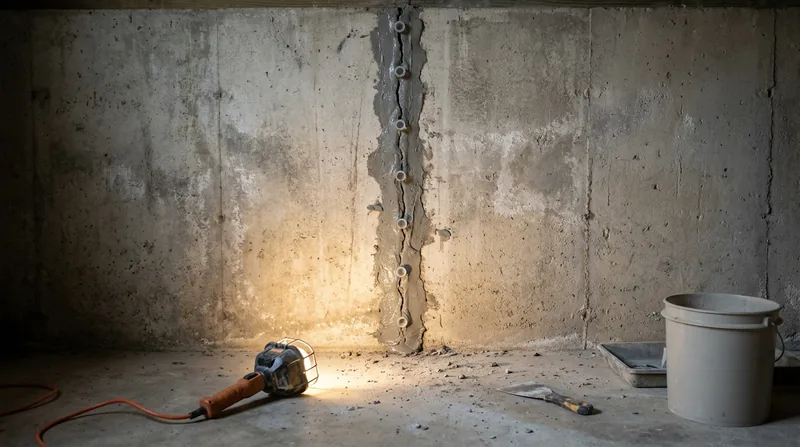
- We drill injection ports at intervals along the crack and seal the surface with a fast-set epoxy.
- We inject epoxy or polyurethane under pressure until the material reaches the far side of the wall.
- We remove the ports, grind the surface flush, and confirm the crack is filled.
- We check grading and downspout extensions so the same water does not find a new path.
When the crack is a symptom of pressure rather than the problem itself, we say so and talk through the alternatives, including an interior drain tile system that relieves the water before it reaches the wall.
Key info: In Island Home Park, a walk-out basement had a leaking cold joint along the footing. The homeowner had already tried hydraulic cement twice. We injected polyurethane from the inside, then extended two downspouts that were dumping water within 18 inches of the wall. The joint stayed dry through the next spring.
Crack Repair Methods We Use and When Each One Fits
Not every crack needs the same material. Here is how we match the method to what the wall is doing, based on the crack type and the ground conditions around your home.
| Approach | Description | Best for |
|---|---|---|
| Epoxy injection | Structural epoxy fills the crack and bonds the concrete back together. | Dry, non-moving vertical or diagonal cracks in poured walls. |
| Polyurethane injection | Flexible foam expands to fill the crack and stop active leaks. | Leaking cracks, cold joints, and cracks that move with the clay. |
| Carbon fiber straps | Straps bolt to the wall and resist inward bowing. | Horizontal cracks and walls that are bowing inward. |
| Wall anchors | Anchors reach into stable soil and pull the wall back toward plumb. | Bowing walls on sloped lots with room to excavate outside. |
If the wall is bowing, we will tell you plainly that injection alone will not fix it and point you toward bowing wall repair.
Foundation Crack Repair Cost in Knoxville: What to Expect
Most single-crack injections in Knoxville start around $450. That covers the inspection, port installation, injection material, and cleanup for a typical vertical crack in a poured wall. The price moves up with crack length, number of cracks, and whether the crack is active or dry. Structural repairs like carbon fiber straps or wall anchors are priced separately because they involve more material and labor.
Access matters too. A crack behind a finished wall or under a low deck takes longer to reach. Cracks in old brick and limestone foundations in Fourth and Gill or Old North Knoxville may need different prep than a 1990s poured wall in Farragut. Getting two or three estimates is smart, and any contractor who quotes a number without looking at the crack is guessing. For a fuller breakdown of what drives pricing, see our pricing overview.
Foundation Crack Repair Near Me: How to Vet a Contractor Around Knoxville
When you search for foundation crack repair near me, you will get a mix of waterproofing specialists, general foundation firms, and handymen. The work is not the same, and neither is the accountability. Ask direct questions before you sign anything.
- Confirm the company is licensed and insured in Tennessee, and ask for a certificate of insurance.
- Get at least two written estimates that specify the injection material and the scope.
- Ask for local references from jobs similar to yours, ideally in your part of Knox County.
- Ask who pulls any permit required for structural work, and verify with the city building department.
- Check whether a transferable warranty is offered and what it actually covers.
We are a Basement Health Association member, and we will tell you when a simple injection is enough and when the real problem is water pressure that needs a drainage solution. Reach out through our contact page to set up an inspection.
Foundation Crack Repair in Knoxville: Pricing Guide
| Service | Price | Details |
|---|---|---|
| Single crack injection (epoxy or polyurethane) | Starting at $450 | Includes inspection, port installation, injection material, and cleanup for a typical vertical crack. |
| Multiple cracks or long cracks | Starting at $750 | Priced by total linear feet and number of injection ports needed along the wall. |
| Structural repair (carbon fiber straps or wall anchors) | On estimate | Requires on-site evaluation of wall movement, soil pressure, and access before quoting. |
| Travel | Included | in Knoxville and surrounding areas, no separate call-out or mileage fee |
| Estimate | Free | Response within 24h at (865) 507-4795, no obligation to book |
Indicative pricing, the exact cost depends on square footage, finish, and site access. Free personalized estimate within 24h at (865) 507-4795.


