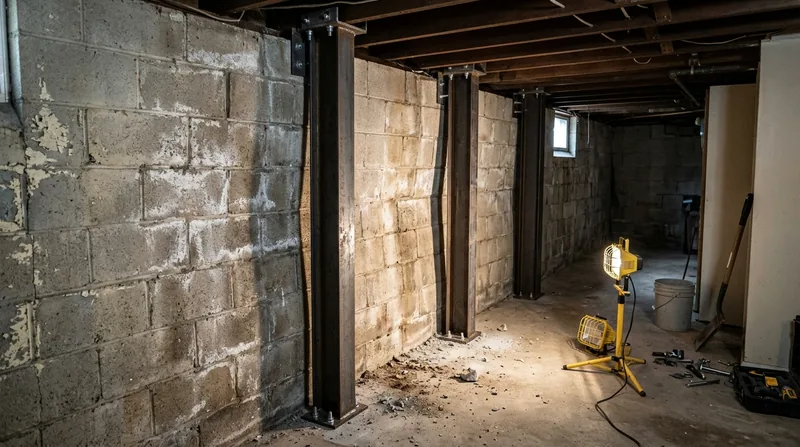




If you have noticed a Bowing Wall Repair in Knoxville problem, you are not alone. The city sits in the Ridge-and-Valley Appalachians beside the Tennessee River, where thick red clay residual soil sits over karst limestone and dolomite. That clay swells hard after our spring storms and pushes relentlessly on uphill foundation walls. In Fourth and Gill and Old North Knoxville, 1880s to 1910s brick and limestone foundations lean and bow. In Holston Hills and Sequoyah Hills, Tudors and Colonials step up steep lots that funnel runoff straight at the back wall. In West Hills, Bearden, and Fountain City, 1950s to 1970s brick ranches and split-levels show the same pattern on their lower levels. We stabilize bowing walls with carbon fiber straps, steel I-beams, or wall anchors, and we match the method to the severity of the movement and the soil under your footing. For the full picture of how water drives this damage, start with our basement waterproofing in Knoxville page.
Why Bowing Walls Are a Knoxville Foundation Problem, Not a Cosmetic One
A bowing wall is a structural warning, not a paint-and-patch issue. In Knoxville, the dominant failure mode is saturated red clay pushing inward on the uphill block or brick wall of a hillside basement. The clay holds water for days after a storm, the hydrostatic pressure builds, and the wall moves inward at mid-height. Freeze-thaw cycles in January and February work the same joints. Left alone, the movement accelerates and the floor joists above start to shift.
- Horizontal cracks in the middle third of the wall signal pressure, not settling.
- A wall that leans more than 1 inch in 8 feet needs an engineer's look.
- Efflorescence and white powder mean water is moving through the block right now.
- Doors and windows that stick on the lower level often track the wall movement.
- Stair-step cracking in brick follows the mortar joints as the wall rotates.
Any one of these signs is reason enough to get the wall evaluated before the next wet spring.
Key info: In Fountain City and Island Home Park, we routinely find walk-out basements where the uphill wall has bowed 1 to 2 inches while the downhill wall is perfectly straight. That pattern is pressure from clay and runoff, not a bad pour, and it changes which repair method fits.
For the code side, the City of Knoxville Plans Review and Inspections office handles structural permits for foundation repair, and thresholds vary by jurisdiction, so confirm requirements before work starts: Knoxville Plans Review and Inspections.
How We Stabilize a Bowing Wall in Knoxville, Step by Step
We start by reading the wall, not by selling a system. The repair has to answer the actual load: clay pressure from uphill, a failing footing drain, or a water table that rises against the wall every spring. We measure the deflection, check the footing, and look at the grading and downspouts that feed the soil. Then we recommend the lightest method that will hold the wall.
- We inspect the wall inside and out, measure the bow, and photograph the crack pattern.
- We check the footing drain and the grading that sends runoff toward the wall.
- We relieve the water source first, because straps alone cannot fight hydrostatic pressure.
- We install carbon fiber straps, steel I-beams, or wall anchors based on severity.
- We seal active cracks with epoxy or polyurethane injection where the wall is otherwise sound.
- We verify the repair and give you a transferable warranty on the stabilization work.
The water source comes first every time, because a dry wall stays put and a wet one keeps moving.
Key info: On a 1960s split-level in West Hills, the uphill block wall had bowed 1.5 inches from clay pressure. We installed carbon fiber straps on 4-foot centers and tied the repair to a new interior perimeter drain, so the wall stopped moving and the basement floor stayed dry through the next spring storm cycle.
When the water is the main driver, the drainage work belongs with our interior drain tile system, which relieves the pressure at the footing before it reaches the wall.
Matching the Repair Method to the Wall and the Soil
No single method fits every bowing wall. The right choice depends on how far the wall has moved, whether the footing is sound, and how much clay pressure the wall carries. We use the table below to compare the options we install in Knoxville.
| Approach | Description | Best for |
|---|---|---|
| Carbon fiber straps | Straps epoxied to the wall from floor to sill, holding the wall against further inward movement. | Bowing under 2 inches with a sound footing and block or poured walls. |
| Steel I-beams | Vertical beams set into the floor and tied to the joists, bracing the wall under load. | Walls bowed 2 to 4 inches or where clay pressure is heavy and persistent. |
| Wall anchors | Anchors driven into stable soil outside, connected through the wall to plates inside. | Walls that need to be pulled back toward plumb on accessible uphill lots. |
| Epoxy or polyurethane injection | Ports set along the crack and resin injected to fill and seal it. | Cracks in a wall that is not yet bowing, or as a complement to straps. |
| Interior drain and membrane | Perimeter drain at the footing plus dimple board to relieve water pressure. | Walls moving because of hydrostatic pressure from saturated clay. |
We match the method to the measurement, and we tell you plainly when simple crack sealing is enough and when the wall needs real structural bracing.
Bowing Wall Repair Cost in Knoxville: What to Expect
Most homeowners want a number before they want a lecture, so here is the honest range. Bowing wall repair in Knoxville starts at From $600 for limited crack injection or a small strap repair, and climbs with the length of wall involved, the number of straps or beams, and how much water control the job needs. A full wall with steel I-beams and an interior drain sits at the top of the range. The soil is the wild card: heavy red clay on a steep Holston Hills lot asks more of the repair than a flat Farragut lot does.
Get two or three estimates and compare the scope, not just the total. A low bid that straps the wall without addressing the water source will cost you again in two springs. Our full pricing overview lays out the line items so you can compare bids apples to apples.
What to Look For in a Bowing Wall Contractor Near Me in Knoxville
Bowing wall work is structural, so hire for competence, not for the fastest callback. Ask for proof of licensing and insurance, and get a certificate of insurance before anyone touches the wall. Get two or three written estimates that describe the method, the measurement, and the water control. Call references on jobs at least a year old. Confirm who pulls the permit, because structural foundation repair commonly requires one in Knoxville and the rules vary by jurisdiction. If your neighborhood has an HOA, check its rules before exterior excavation or anchor installation.
We are a Basement Health Association member, and we will tell you when a repair is not yet needed. Reach us through our contact page to set up a free inspection, or call (865) 507-4795 and we will get a technician out within 24 hours.
Bowing Wall Repair in Knoxville: Pricing Guide
| Service | Price | Details |
|---|---|---|
| Crack injection (epoxy or polyurethane) | Starting at $600 | Seals active cracks in a wall that is not yet bowing, priced by crack length and access. |
| Carbon fiber strap installation | Starting at $1,200 | Straps on 4-foot centers for bowing under 2 inches, priced by wall length and footing condition. |
| Steel I-beam bracing | On estimate | For walls bowed 2 to 4 inches or heavy clay pressure, needs an on-site measurement first. |
| Wall anchors | On estimate | Requires accessible uphill soil and an engineer's pull-back plan, so we quote after inspection. |
| Travel | Included | In Knoxville and surrounding areas, no separate call-out or mileage fee. |
| Estimate | Free | Response within 24h at (865) 507-4795, no obligation to book the work. |
Indicative pricing, the exact cost depends on square footage, finish, and site access. Free personalized estimate within 24h at (865) 507-4795.


